What Is Digital Printing? Types, Benefits Uses
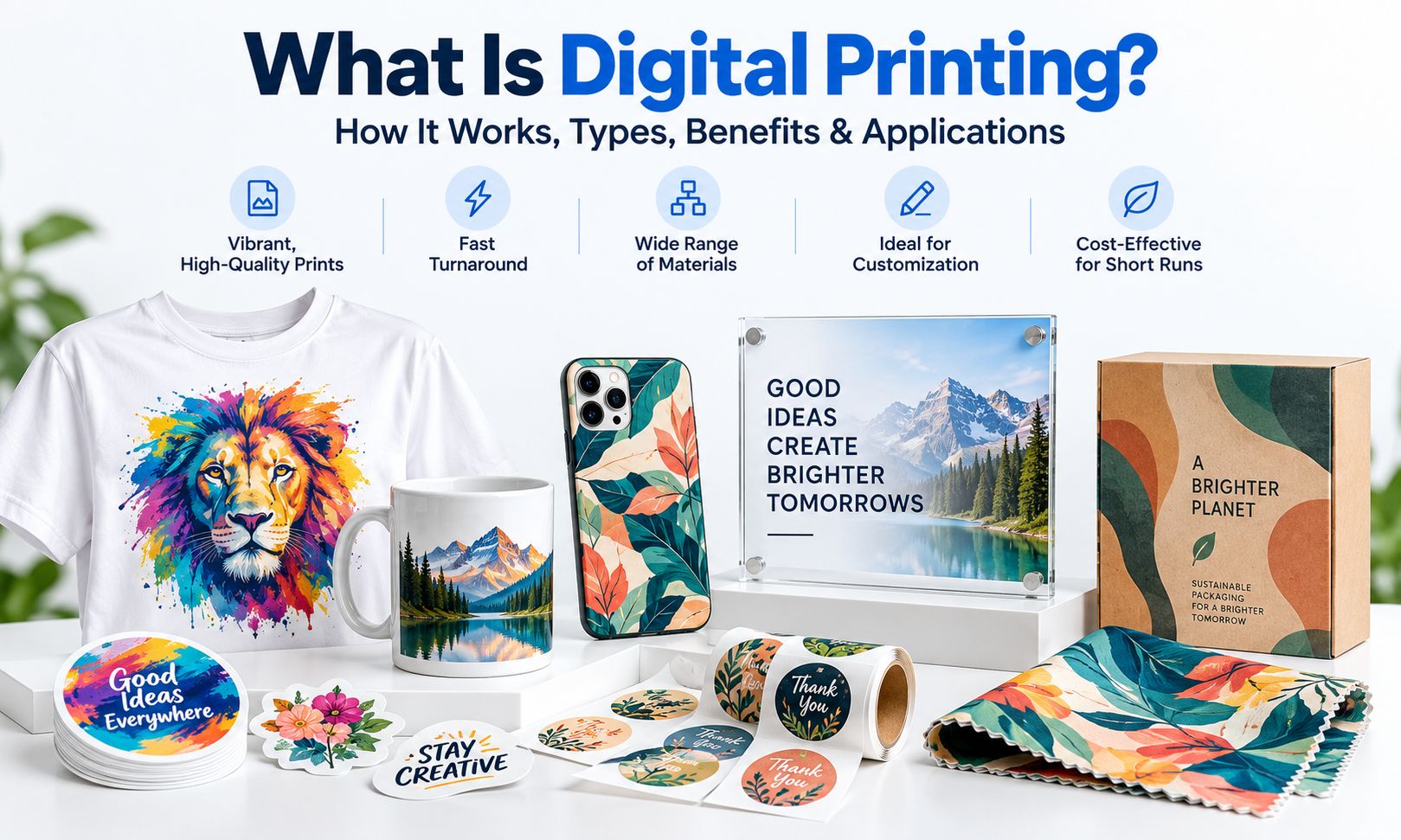
Digital printing is a printing process that uses digital files to reproduce text, graphics and images on physical materials without requiring a traditional fixed printing plate or screen for each design. Unlike conventional processes that rely on prepared image carriers, digital printing equipment receives electronic image data and controls where ink, toner or another imaging material is applied. This makes digital printing particularly useful for short production runs, personalized products, variable-data printing, rapid prototyping and on-demand manufacturing. Today, digital printing extends far beyond paper. It is used for: Business cards, brochures and packaging Custom T-shirts, hoodies and tote bags Personalized phone cases Acrylic signs and decorative panels Wood and metal products Glass and ceramic gifts Stickers, labels and product decals Custom mugs and promotional drinkware However, digital printing is not one specific printer technology . An office laser printer, a commercial inkjet press, a textile DTF printer and a UV flatbed printer are all examples of digitally controlled printing systems, even though they use different inks, materials and production methods. Understanding these differences is essential when choosing the right printing process for a product or business. In this guide, we explain how digital printing works, its major technologies, how it compares with traditional printing, and how businesses can choose between different digital printing methods. What Is Digital Printing? Digital printing is the process of converting electronic artwork into printed output using a digitally controlled printing system. The image originates from a file such as a PDF, TIFF, JPEG or another supported format. The printer then reproduces the image using an appropriate imaging system. Depending on the technology, the printing process may involve: Liquid ink droplets Dry or liquid toner UV-curable ink Water-based textile ink Sublimation ink Heat-transfer media Specialized printing films The defining characteristic is that the image can be controlled digitally rather than requiring a separate conventional printing plate or screen for each design. What Makes Printing Digital? Three characteristics help distinguish digital printing from many traditional printing processes. 1. Digital image control The artwork is supplied and processed electronically. 2. No conventional fixed image plate for each design The printing system does not require a new traditional offset plate or screen whenever the artwork changes. 3. Flexible image changes Individual pieces can contain different: Names Photographs Serial numbers QR codes Logos Personalized graphics This capability is often called variable data printing . For example, a company could produce 100 personalized promotional items, each displaying a different employee name, without preparing 100 separate conventional printing plates. Does Digital Printing Always Print Directly onto the Final Product? No. This is an important distinction. Some digital technologies print directly onto the final substrate. For example: Digital File → UV Printer → Acrylic Panel Other technologies use an intermediate transfer material. For example: Digital File → Textile DTF Film → Adhesive Powder → Heat Transfer → T-Shirt Both processes are digital printing. The use of transfer film does not make a process non-digital. How Does Digital Printing Work? Although different digital printing technologies use different physical mechanisms, most follow a similar production sequence. A simplified workflow is: Digital Artwork → RIP / Print Control → Image Formation → Drying / Curing / Fusing / Transfer → Finished Product Step 1: Prepare the Digital Artwork Printing begins with a digital design. The artwork may contain: Photographs Text Logos Illustrations Vector graphics Variable data White ink layers Varnish or specialty layers The file should be prepared according to the intended output size and printing process. For close-view raster images, approximately 300 DPI at final size is often a practical starting point, although requirements vary by application and printer. Vector graphics are generally preferable for sharp logos, text and line artwork. Step 2: Process the File The design is sent to compatible printing software. Depending on the system, this may include a RIP, or Raster Image Processor. A RIP converts the artwork into instructions the printer can use. It may control: Image positioning Color separation Ink density Print resolution Print passes White ink layers Varnish layers Output profiles Commercial production requires more than simply clicking Print. The software, ink, substrate and printer must work together. Step 3: Create the Printed Image The image-formation process depends on the printer technology. An inkjet printer deposits controlled droplets of ink. An electrophotographic printer uses an electrostatic image-formation process to transfer toner. Both are digital processes, but their mechanisms are fundamentally different. For an explanation of inkjet technology, read What Is an Inkjet Printer and How Does It Work? . Step 4: Dry, Cure, Fuse or Transfer Not every digital printing process fixes the image to the material in the same way. Printing Technology Main Post-Imaging Process Water-based Inkjet Drying, absorption or other process-specific fixation Digital Toner Heat/pressure fusing or another toner-specific fixation process UV Printing UV curing Textile DTF Adhesive powder curing and garment heat transfer UV DTF UV curing, film lamination and adhesive transfer Sublimation Transfer Heat-driven dye transfer into a compatible polymer These different methods explain why printing equipment and consumables cannot simply be interchanged. Step 5: Inspect the Finished Product Quality control may include checking: Color accuracy Print resolution Image positioning Surface adhesion White ink opacity Transfer completeness Durability Finished dimensions For commercial production, the final product—not only the artwork on the computer—must meet the customer's requirements. What Are the Main Types of Digital Printing? The two most widely recognized digital imaging technologies are inkjet printing and electrophotographic printing . Many familiar commercial printing methods are applications or specialized configurations built around these image-formation technologies. 1. Inkjet Digital Printing Inkjet printing uses microscopic nozzles to deposit precisely controlled droplets of liquid ink. Different inkjet systems may use: Water-based dye ink Water-based pigment ink UV-curable ink Solvent or eco-solvent ink Latex ink Textile ink Sublimation ink Inkjet printing is used for everything from desktop photographs to industrial product customization. Its versatility comes from the range of available printheads, inks, equipment configurations and substrate-handling systems. However, an inkjet printer designed for paper cannot automatically print on metal, glass or fabric. 2. Electrophotographic / Digital Toner Printing Electrophotographic printing uses electrical charges to form an image, attract toner and transfer it onto the printing material. Dry-toner systems generally use heat and pressure to fuse toner onto the substrate. This technology is common in: Office laser printers Commercial digital presses Document printing Short-run brochures Business cards Personalized paper products Liquid electrophotographic systems also exist, using their own imaging and transfer mechanisms. This category is particularly important for digital printing of paper-based commercial products. 3. UV Digital Printing UV printing is a specialized inkjet process that uses UV-curable ink. After the ink is deposited, UV light initiates the curing process. UV flatbed printing is commonly used for suitable: Acrylic Plastic Wood Metal Glass Ceramic Phone cases Signs Promotional products On supported systems, white ink and varnish can provide additional visual effects. For example, white ink can improve opacity on black acrylic, while varnish can create selected gloss or decorative texture. UV printing still requires careful substrate preparation and adhesion testing. Explore the EraSmart UV Printing Guide for a detailed explanation. 4. Textile DTF Printing DTF stands for Direct to Film. In textile DTF printing, the image is printed onto PET transfer film instead of directly onto a garment. The transfer is then prepared using adhesive powder and curing. Finally, a heat press transfers the design onto compatible fabric. The workflow is: Artwork → PET Film → CMYK + White → Adhesive Powder → Curing → Heat Press → Garment Common applications include: Custom T-shirts Hoodies Uniforms Tote bags Sportswear Personalized clothing Textile DTF is useful for mixed garment orders, short production runs and designs containing multiple colors. Explore EraSmart DTF Printers . 5. UV DTF Printing UV DTF combines UV-curable inkjet printing with a specialized film-transfer workflow. Unlike textile DTF, it does not use conventional garment adhesive powder or a garment heat press. The workflow typically involves: Artwork → UV DTF Film A → UV Printing → Film B Lamination → Transfer Application UV DTF is used for compatible hard-surface products such as: Bottles Tumblers Jars Promotional gifts Decorative labels Hard-surface decals Cup wraps The graphic is printed before being applied to the final object. This is particularly useful for certain curved or irregular products that are difficult to position under a conventional flatbed printhead. Explore EraSmart UV DTF Printers . 6. Direct-to-Garment (DTG) Printing DTG is another textile-oriented inkjet technology. Instead of printing onto transfer film, the printer deposits textile ink directly onto a suitable garment. The printed garment then undergoes the required fixation or curing process. DTG and textile DTF are different workflows. DTG may be useful for direct garment decoration, while DTF provides a separate film-based transfer process. The better choice depends on garment materials, production requirements, pretreatment, finished hand feel and total operating costs. 7. Dye-Sublimation Printing Dye sublimation is commonly used for: Polyester fabric Sublimation-coated ceramic mugs Coated metal photo panels Selected personalized gifts In a typical small-business transfer workflow, the artwork is first printed with sublimation ink onto suitable paper. Heat then transfers the dye into a compatible polymer material or coating. Unlike UV printing, conventional dye sublimation does not create a separate opaque white ink underbase. Sublimation also requires suitable substrates; an ordinary uncoated ceramic mug is not automatically compatible. Learn more in What Is Sublimation Paper? . 8. Latex and Other Specialized Inkjet Printing Latex printing commonly uses water-based ink formulations and controlled heating to form a durable printed layer on compatible media. Typical applications may include: Posters Banners Wall graphics Signs Decorative films Like UV and textile inkjet, latex is a specialized inkjet workflow, not a subtype of toner electrophotography. Digital Printing Technologies at a Glance Technology Imaging / Workflow Typical Products Inkjet Liquid ink droplets Paper, photos, signs and industrial products Electrophotographic Electrostatic imaging and toner Documents, brochures, commercial print UV Flatbed UV-curable inkjet Acrylic, wood, metal, phone cases Textile DTF Inkjet plus film and heat transfer T-shirts, hoodies, fabric goods UV DTF UV inkjet plus film transfer Cup wraps, labels, decals DTG Direct textile inkjet Garments Dye Sublimation Dye transfer into compatible polymer Coated mugs, polyester products Latex Specialized water-based inkjet Signage and flexible media The important distinction is between the image-formation technology and the complete production workflow . Digital Printing vs Traditional Printing: What's the Difference? Traditional printing technologies typically use an image carrier or printing form that must be prepared for a particular design. Examples include: Offset printing plates Screen printing stencils Flexographic printing plates Digital printing controls image formation electronically. This difference affects setup, production flexibility and the economics of printing different quantities. Digital Printing vs Offset Printing Offset printing is a major conventional commercial printing process. In offset lithography, ink is transferred from a printing plate to a rubber blanket and then onto the substrate. Once the press has been prepared, offset printing can be highly efficient for large quantities of identical work. Digital printing avoids conventional offset platemaking, making it attractive for smaller or frequently changing jobs. Factor Digital Printing Offset Printing Image Control Digital file Conventional printing plates Initial Setup Generally lower for short runs Platemaking and press setup required Small Quantities Often economical Setup cost can be significant Large Quantities Depends on equipment and cost structure Often highly efficient Personalization Strong variable-data capability Requires additional arrangements Artwork Changes Generally easier between impressions May require new plates Turnaround Often faster for short jobs Depends on setup and scheduling Color Control Profile- and device-dependent Strong standardized commercial workflows Material Options Depends on digital press Depends on press and substrate When Is Digital Printing Better? Digital printing is often a good choice when: The order quantity is small. Every printed item is different. Artwork changes frequently. Customers need fast sampling. There is demand for personalized content. Products are manufactured on demand. When Is Offset Printing Better? Offset may be more economical when: Thousands of identical pieces are required. The design is stable. Long-run productivity is important. Conventional offset inks or finishes are required. The overall production specification favors offset equipment. There is no universal order quantity at which offset automatically becomes cheaper than digital. The crossover depends on equipment, material, finishing, labor, waste and the specific job. For further background on commercial printing methods, see the University of Tennessee's Digital Printing and Offset Printing explanations. Digital Printing vs Screen Printing Screen printing transfers ink through a prepared stencil or screen. It is widely used for: Apparel Posters Promotional products Industrial graphics For large quantities of the same design, screen printing can be highly efficient. However, multi-color artwork generally requires appropriate screen preparation and registration. Digital methods such as DTF are useful when businesses need: Multiple colors Photographic images Frequent design changes Personalized garments Smaller order quantities Neither process is automatically best for every textile product. Digital Printing vs Flexographic Printing Flexography uses flexible printing plates and is widely used for packaging and labels. It can be highly productive for large-volume repeat jobs. Digital label and packaging printing can be more suitable for: Short runs Packaging prototypes Multiple product variations Seasonal labels Frequent artwork changes The choice depends on the printing material, quantity, ink requirements and finishing process. What Are the Advantages of Digital Printing? Digital printing is valued for production flexibility. 1. Short-Run Production Digital printing can reduce the need for conventional setup and platemaking. This can make smaller quantities economically practical. For example, a gift shop may need only 20 personalized acrylic plaques. Preparing conventional plates or screens for a small order may be unnecessary when a compatible digital UV printing workflow is available. 2. Personalization Each item can contain different content. Examples include: Individual names on shirts Different photographs on phone cases Unique QR codes on cards Custom logos on promotional gifts Personalization is one of the most important commercial advantages of digital printing. 3. On-Demand Production Businesses can manufacture products after receiving an order rather than holding large quantities of preprinted inventory. This is particularly relevant for: Print-on-demand stores Customized gifts Local print shops Small apparel brands E-commerce sellers However, on-demand production still requires appropriate inventory of blanks and consumables. 4. Faster Artwork Changes Digital printing makes it easier to switch between designs. A print shop may produce: One family photo mug Five personalized phone cases Ten different logo stickers without preparing separate conventional printing plates for every image. 5. Rapid Prototyping Digital printing is useful for product development. Businesses can evaluate: Packaging graphics Label placement Brand colors Product prototypes Promotional designs before committing to a large order. 6. Variable Data Printing Digital systems can print changing information between impressions. For example: Product A — Serial 001 Product A — Serial 002 Product A — Serial 003 This is useful for selected labels, identification products and promotional applications. The actual implementation depends on the printing software and production system. 7. Product Customization Different digital workflows make it possible to customize a broad range of products. That does not mean one machine can print everything. It means businesses can select specialized equipment according to their product requirements. What Are the Limitations of Digital Printing? Digital printing also has practical limitations. Understanding them helps businesses avoid choosing equipment that does not match their production needs. Consumable Costs Depending on the technology, production may require: Specialized ink Toner Printing film Adhesive powder Transfer paper Coated blanks Cleaning materials Consumable costs can become significant at high production volumes. Large-Volume Economics Traditional processes such as offset and screen printing can be highly efficient for long runs of identical designs. A digital process that works well for 20 personalized items may not provide the lowest cost for 100,000 identical pieces. Material Compatibility A digital printer is not universally compatible with every substrate. UV printing on plastic, for example, depends on the polymer, coating, ink and surface preparation. Some materials require: Cleaning Primer Surface treatment Special coatings Alternative ink chemistry Compatibility must be validated on the actual production material. Printer Maintenance Inkjet systems require regular care. Depending on the technology, maintenance may include: Nozzle checks Printhead cleaning Capping station inspection White ink circulation Media handling Environmental control A printer that uses white pigment ink may require more attention than a basic office printer. Color Consistency Digital printing does not automatically guarantee identical color on every material. Color appearance can depend on: Ink Print profile White underbase Material color Coating Printer condition Viewing light For practical color management, see How to Print the Correct Colors . Durability Requirements A design that prints successfully is not necessarily durable enough for its intended use. Different applications may require testing for: Adhesion Washing Flexing Abrasion Moisture Outdoor exposure Chemical contact Always evaluate the complete finished product. What Materials Can Be Digitally Printed? Digital printing covers a broad range of materials because different technologies are engineered for different applications. Paper and Cardboard Common applications include: Business cards Brochures Books Labels Flyers Packaging prototypes Production inkjet and electrophotographic systems are common technologies for paper-based commercial printing. Fabric and Apparel Digital textile printing may include: Textile DTF DTG Dye sublimation Other textile inkjet processes Applications include: T-shirts Hoodies Sportswear Uniforms Tote bags Fabric composition, pretreatment, ink chemistry and finishing requirements determine the suitable workflow. Acrylic and Plastic UV printing is frequently used for suitable rigid plastic and acrylic products. Applications include: Acrylic signs Display panels Phone cases Nameplates Promotional products Transparent acrylic can benefit from white ink backing or reverse printing. Different plastics behave differently, so adhesion testing remains important. See UV Printer for Acrylic . Wood UV printing can be used for suitable wood and wood-based products. Applications include: Decorative signs Wooden plaques Personalized gifts Home décor Packaging samples The natural grain, coating, porosity and surface flatness can affect the final result. Metal Digital UV printing can customize compatible metal surfaces. Possible products include: Metal signs Nameplates Awards Promotional plates Decorative panels Metal often requires careful cleaning and may need additional surface treatment depending on the finish. Read UV Printing on Metal . Glass and Ceramic UV printing and UV DTF can be used for selected glass and ceramic applications. Sublimation is another option for specially coated products. Examples include: Decorative glass Ceramic tiles Personalized mugs Glass gifts Promotional drinkware Food-contact and dishwasher-safety claims require application-specific testing. Film, Vinyl and Specialty Media Different printing technologies use different film materials. Examples include: Textile DTF PET film UV DTF A/B film Printable vinyl Sublimation transfer paper Specialty inkjet media These materials are not universally interchangeable. Common Applications of Digital Printing Digital printing serves both traditional commercial printing and specialized product customization. Application Typical Technology Business cards and brochures Digital toner / production inkjet Personalized T-shirts Textile DTF / DTG Polyester products Sublimation Acrylic signage UV flatbed Custom phone cases UV flatbed Wooden gifts UV flatbed Metal nameplates UV flatbed Cup wraps and hard-surface decals UV DTF Sublimation-coated photo mugs Sublimation Short-run packaging samples Suitable digital inkjet or toner process The common connection is digital image control. But the equipment, inks, materials and finishing procedures differ. UV vs DTF vs UV DTF: Which Digital Printing Technology Should You Choose? For custom-product businesses, UV, textile DTF and UV DTF are three important technologies. They serve different production goals. UV Flatbed Printing Choose UV flatbed when you want to print directly onto compatible hard products. Typical products include: Acrylic plaques Phone cases Signs Wooden gifts Flat metal products Packaging prototypes Textile DTF Printing Choose textile DTF when your primary products are garments or other compatible fabric items. Typical products include: T-shirts Hoodies Uniforms Tote bags UV DTF Printing Choose UV DTF when you want to produce adhesive transfer graphics for compatible hard surfaces. Typical products include: Cup wraps Bottle decals Decorative labels Promotional graphics Business Goal Recommended Starting Technology Custom apparel Textile DTF Direct printing on rigid products UV Flatbed Hard-surface decals and cup wraps UV DTF Paper brochures Production Inkjet / Digital Toner Sublimation-coated gifts Dye Sublimation For a more detailed buying comparison, read UV Printing vs DTF Printing vs UV DTF Printing . How to Choose the Right Digital Printing Method The best technology depends on the product you want to manufacture—not simply the printing technology that appears most versatile. Step 1: Identify the Final Product Start by asking: What am I actually selling? For example: T-shirts Acrylic signs Phone cases Bottles Stickers Paper packaging The finished product immediately narrows the available printing methods. Step 2: Identify the Material Determine whether the product is made from: Cotton Polyester Acrylic Glass Metal Wood Plastic Paper A coated material Do not choose a printer before confirming substrate compatibility. Step 3: Consider Product Shape and Size A flat acrylic panel is different from a cylindrical bottle. A UV flatbed can be practical for the panel. A UV DTF transfer may be more convenient for decorating a compatible curved bottle. Direct cylindrical UV printing, by comparison, requires a suitable rotary system. Step 4: Consider Order Quantity Think about: One-off orders Short runs Mixed-design batches Large repeat orders Digital printing often works well for variable designs and smaller batches, but commercial production capacity still needs to be evaluated. Step 5: Consider Color and Special Effects Does the product need: CMYK only? White ink? Transparent effects? Varnish? Full-color photographs? Textured finishes? Not every digital printing system supports all of these features. Step 6: Calculate Total Production Cost Evaluate more than the equipment purchase price. Consider: Total Production Cost = Consumables + Labor + Maintenance + Equipment Allocation + Packaging + Waste + Other Relevant Overheads The actual calculation should reflect your business model. Step 7: Evaluate Maintenance and Workflow Some technologies require: Regular ink circulation Powder application Heat pressing Lamination Surface treatment Specialized finishing Choose equipment your team can operate and maintain consistently. Step 8: Test Actual Products Before purchasing equipment for a new business, evaluate physical samples. Check: Image quality Material compatibility Durability Production time Ink consumption Waste Finished appearance A sample that passes the intended application tests provides more useful information than a generic equipment specification alone. Is Digital Printing Suitable for Small Businesses? Digital printing can be a practical production method for small businesses because it supports individualized orders and a wide range of short-run applications. Potential business models include: Print-on-Demand Apparel Produce custom garments after receiving customer orders. Personalized Gift Shops Offer products such as: Phone cases Acrylic gifts Name plaques Promotional items Sticker and Decal Businesses Produce customized decals for compatible hard-surface products. Local B2B Customization Supply small quantities of: Company gifts Branded products Promotional displays Event merchandise E-Commerce Businesses Sell personalized products through websites and online marketplaces. However, profitability depends on: Customer demand Product pricing Consumable costs Equipment utilization Marketing Order fulfillment Maintenance Reprint rates A digital printer is a production tool, not a guarantee of profit. Businesses should validate a small product range before expanding into many unrelated applications. Common Digital Printing Problems and How to Prevent Them Even professional equipment can experience printing problems. Understanding where problems originate helps reduce unnecessary reprints. Inaccurate Colors Possible causes: Incorrect color profile Different substrate colors White ink variation Inappropriate RIP settings Check color management before changing several printer settings simultaneously. Banding Possible causes: Missing nozzles Printhead alignment Media feeding Incorrect print mode Run diagnostic tests according to the printer's operating procedure. Poor Adhesion Common in some direct-to-object printing applications. Check: Substrate Surface contamination Ink compatibility Pretreatment Curing Do not assume that simply increasing print resolution will improve adhesion. White Ink Problems White pigment systems require appropriate circulation, cleaning and maintenance. Problems may include: Uneven opacity Nozzle loss Settling Inconsistent white coverage Blurry Images Check: Source resolution Artwork dimensions Printhead clearance Printer setup Media movement Transfer Problems Textile DTF and UV DTF use different transfer processes. For textile DTF, check: Powder coverage Curing Heat press conditions Film For UV DTF, check: A/B film Lamination Surface cleaning Application pressure Adhesion Troubleshoot the specific production system rather than assuming all digital printing problems have the same causes. Is Digital Printing Better for the Environment? Digital printing can reduce some forms of waste, particularly when businesses produce only what customers order. For example, on-demand production may reduce the need to manufacture large quantities of unwanted printed merchandise. Digital printing can also eliminate certain conventional platemaking steps. However, this does not mean every digital printing process is automatically environmentally preferable. Environmental impact depends on: Ink chemistry Energy consumption Film and transfer materials Waste ink Cleaning supplies Production volume Packaging Equipment lifetime Finished-product durability UV, DTF, UV DTF and other printing technologies have different consumable and waste profiles. Environmental claims should be based on the actual process and credible supporting evidence, not on the word digital alone. Final Answer: When Should You Choose Digital Printing? Digital printing is a broad family of production processes that use electronic image data to control printing without preparing conventional fixed plates or screens for every design. It is particularly valuable when businesses need: Short production runs Personalized products Variable artwork On-demand manufacturing Fast sampling Frequent design changes Traditional printing processes may remain more economical for some large-volume standardized applications. For custom-product businesses, the most important decision is selecting the right digital workflow. Choose Textile DTF for compatible apparel and fabric transfers. Choose UV Flatbed for direct printing on suitable rigid and specialty products. Choose UV DTF for hard-surface transfer decals, cup wraps and compatible finished goods. Choose Sublimation for appropriate polyester and specially coated products. Choose Production Inkjet or Digital Toner for suitable paper-based commercial printing. The right printing process should match the product, substrate, required quality and production economics. Frequently Asked Questions What is digital printing in simple terms? Digital printing creates physical prints using electronically controlled image data without requiring traditional fixed printing plates or screens for each design. How does digital printing work? A digital file is processed by printing software, and a printer forms the image using ink, toner or a specialized process. The image is then dried, cured, fused or transferred according to the technology. What are the main types of digital printing? Inkjet and electrophotographic printing are two major image-formation technologies. Specialized workflows include UV printing, textile DTF, UV DTF, DTG, sublimation and latex printing. Is inkjet printing the same as digital printing? No. Inkjet is one major type of digital printing. Digital printing also includes electrophotographic and other digitally controlled imaging technologies. Is UV printing a type of digital printing? Yes. UV printing is a specialized digital inkjet process that uses UV-curable ink. What is the difference between digital printing and offset printing? Digital printing uses electronic image control without conventional plates for each design. Offset printing uses prepared plates and transfers ink through an intermediate blanket to the substrate. Is digital printing cheaper than offset printing? Digital printing is often economical for short runs and personalized work. Offset can be more efficient for long runs. Actual cost depends on the job and equipment. What materials can be digitally printed? Depending on the technology, digital printing can be used on paper, fabric, plastic, acrylic, wood, metal, glass, ceramic and specialized films. Can digital printing be used on T-shirts? Yes. Textile DTF, DTG and suitable sublimation workflows are examples of digital methods used for garment customization. Can digital printing work on metal or glass? Yes, with suitable technology such as compatible UV printing or UV DTF transfers. Surface preparation and adhesion testing may be necessary. Does digital printing last as long as screen printing? Durability depends on the ink, substrate, printing process, finishing and actual use. Neither method should be assumed universally superior. Do digital printers require maintenance? Yes. Maintenance varies by technology. Inkjet systems may require nozzle checks and ink-system care, while toner-based systems have different maintenance requirements. Does digital printing require special ink? It depends on the printer. UV ink, textile ink, sublimation ink and toner are designed for different systems and are not universally interchangeable. Is digital printing suitable for small businesses? It can be, especially for personalization, small-batch production and on-demand products. Profitability depends on actual demand and operating costs. Which digital printing method is best for personalized gifts? For flat rigid gifts, UV flatbed may be suitable. For compatible hard-surface decals and cup wraps, consider UV DTF. For textile gifts, consider textile DTF.
High-quality Direct to Film Printers for cotton, polyester, leather & more. No pretreatment, fast speed, wash-resistant.
High-quality UV Printers for metal, acrylic, glass, wood & more. Instant curing, vivid 1440dpi prints, versatile for diverse materials.
Print vivid, raised decals with **CMYK + White + Varnish** in one pass. No powder. No oven. Peel and stick on flat or curved items in minutes.