Decal vs Sticker: What Is the Difference and Which One Should Your Business Sell?
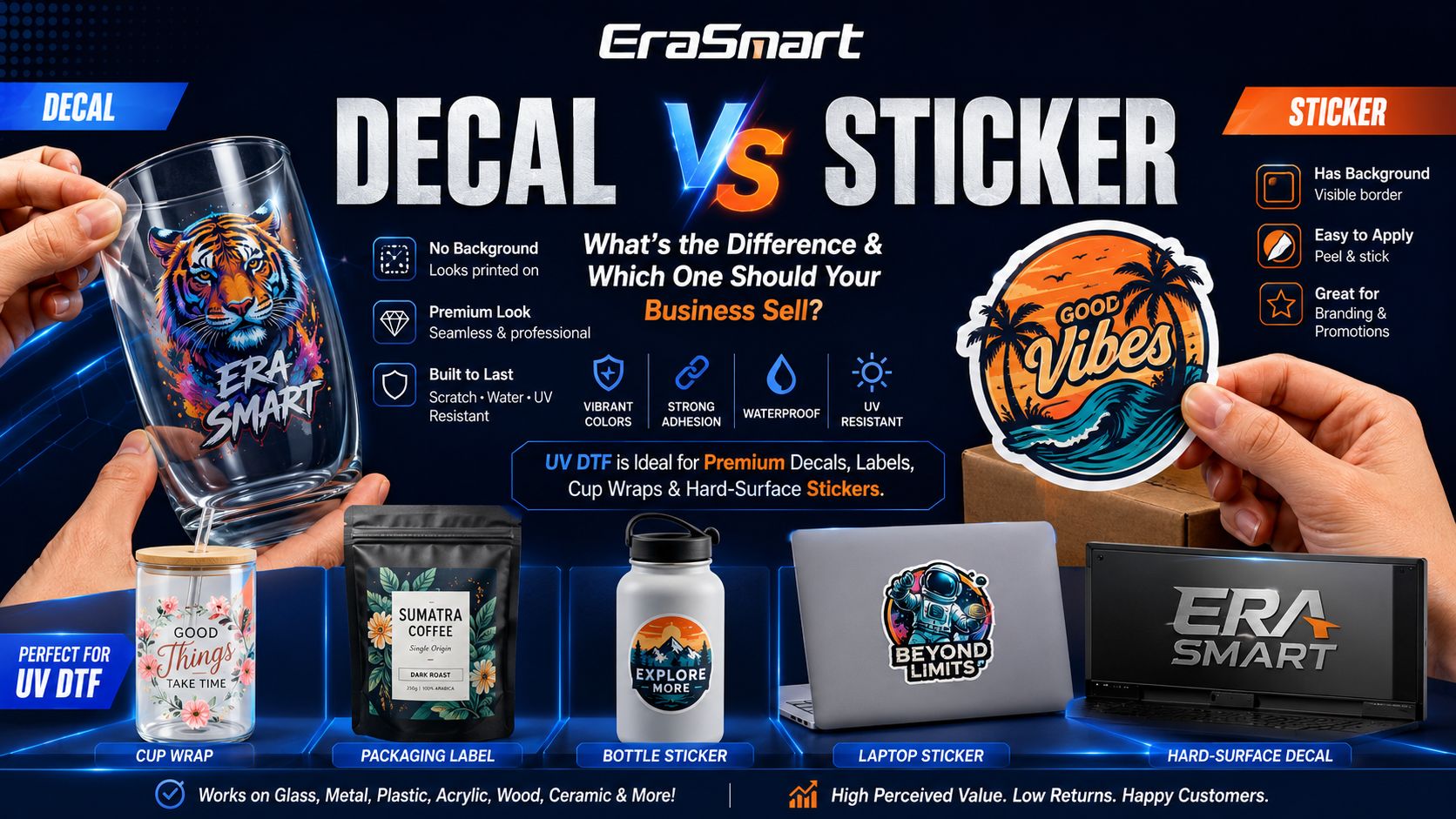
Decals and stickers are both adhesive graphics, but they are not always used in the same way. For a customer, the difference may seem small. For a printing business, the difference matters because it affects material choice, application method, product positioning, durability, pricing, and the equipment you need. In simple terms, a sticker is usually a standalone adhesive graphic used for decoration, branding, packaging, or promotion. A decal is usually a transfer-style graphic designed to be applied more cleanly onto a surface, often with little or no visible background. In the custom printing market, stickers are often used for giveaways, laptops, bottles, packaging inserts, and product decoration, while decals are commonly used for windows, walls, vehicles, signs, cup wraps, branding graphics, and hard-surface transfers. Print industry explanations commonly separate stickers, labels, and decals by purpose, format, and application method: stickers are usually standalone promotional pieces, labels are more functional and packaging-focused, and decals are often transfer-applied graphics for cleaner placement. A UV DTF transfer can look like a premium sticker, behave like a decal, and be sold as a high-value hard-surface customization product for cups, glass, metal, acrylic, wood, packaging, and gadgets. EraSmart’s A3 UV DTF Printer is designed exactly for this type of product, using CMYK + White + Varnish, A/B film, cold lamination, and a powderless peel-and-stick workflow.
Quick Answer: Decal vs Sticker Factor Sticker Decal Basic meaning Standalone adhesive graphic Transfer-style adhesive graphic Common use Branding, decoration, giveaways, packaging inserts Windows, walls, vehicles, cup wraps, hard-surface branding Application Peel and stick Transfer, press, burnish, then peel carrier Background Often has a visible border or backing shape Often leaves only the graphic on the surface Best for Simple graphics, logo stickers, product extras Clean logos, lettering, wraps, premium hard-surface decoration Business value Easy to sell in volume Higher perceived value for custom products UV DTF fit Premium stickers for hard goods Premium decals, labels, cup wraps, and transfers The simplest way to decide is this: use “sticker” when the product is sold as a standalone adhesive graphic; use “decal” when the design is transferred onto a product surface for a cleaner, more integrated look.
What Is a Sticker? A sticker is an adhesive-backed graphic that can be peeled from a backing and applied directly to a surface. Stickers can be paper, vinyl, BOPP, clear film, holographic film, foil, embossed material, or UV DTF transfer-style material. In many print businesses, stickers are used for logos, packaging extras, laptop decoration, water bottles, retail giveaways, product inserts, event merch, and small brand promotions. Stickers are usually easy to understand and easy to sell. They can be produced in many shapes, sizes, finishes, and quantities. Some are budget-friendly and temporary, while others are more durable and premium. For example, paper stickers are suitable for indoor packaging and low-cost labeling, while vinyl stickers are more durable and waterproof for bottles, laptops, and outdoor use. Sticker material selection directly affects durability, appearance, and where the sticker can be used. For a small business, stickers are attractive because they can be sold as: brand logo stickers
If the customer simply wants a graphic they can peel and place, “sticker” is usually the word they understand first.
What Is a Decal? A decal is also an adhesive graphic, but it is usually associated with a transfer-style application. Instead of applying a full sticker shape with a visible background, the goal is often to leave only the printed or cut graphic on the surface. This is why decals are commonly used for windows, car graphics, storefront lettering, wall graphics, product branding, and hard-surface decoration. In many printing workflows, decals may use transfer tape or carrier film to keep separated elements aligned during application. This is especially useful for lettering, logos, detailed graphics, and larger designs that need clean placement. Print industry references often define decals as transfer graphics or lettering applied to windows, vehicles, walls, or similar surfaces. For a business, decals are useful for: window logos
Decals usually feel more “finished” than basic stickers because the final result can look printed directly onto the object.
Where UV DTF Changes the Decal vs Sticker Conversation Traditional stickers and decals often depend heavily on vinyl, transfer tape, die cutting, and manual weeding. UV DTF changes the workflow because the design is printed onto A film, laminated with B film, then applied to the product surface. After the carrier is removed, the printed design remains on the object with a glossy or raised finish. EraSmart’s UV DTF workflow is simple: print on A film with CMYK + White + Varnish, cold-laminate with B film, trim or kiss-cut, burnish, peel, and apply. The A3 UV DTF system supports up to 350 mm width, up to 1440 dpi, A/B UV DTF films, and best-use cases such as stickers, labels, cup wraps, and gadget skins. This means one UV DTF product can be described in different ways depending on the customer: UV DTF sticker when sold as a premium adhesive graphic.
UV DTF decal when applied as a transfer to a hard surface.
UV DTF label when used for product branding or packaging.
UV DTF cup wrap when designed for tumblers, mugs, or bottles.
UV DTF transfer when the buyer focuses on the application process.
From a sales perspective, this is important. Customers may search different terms, but the production method can be the same.
Decal vs Sticker vs Label: Do Not Confuse the Buyer A sticker, decal, and label can overlap, but they usually have different business purposes. Term Main Purpose Typical Format Common Products Sticker Decoration, promotion, personal expression Individual pieces or sheets Laptop stickers, bottle stickers, logo stickers Label Product information, packaging, branding Rolls or sheets Jars, bottles, boxes, shipping labels Decal Transfer-style surface graphics Transfer film or carrier layer Windows, cups, vehicles, gadgets, walls Labels are usually functional and packaging-driven. Stickers are usually decorative or promotional. Decals are usually transfer-applied graphics for cleaner placement. This is not only a terminology issue; it changes how you design, price, package, and market the product. For EraSmart users, UV DTF can support all three business directions, especially when the target products are hard surfaces.
When Should You Sell Stickers? Sell stickers when the customer wants a simple, easy-to-apply graphic for branding, decoration, or promotion. Stickers are especially useful when the buyer wants quantity, easy distribution, or a low-friction product. Sticker-style products are suitable for: online sticker shops
If your business wants a lower-barrier product that customers already understand, stickers are easy to start with. However, the market is competitive, so the key is to offer better finish, better durability, better design, or more specialized applications.
When Should You Sell Decals? Sell decals when the customer wants a cleaner, more permanent, more professional surface graphic. Decals are better when placement matters, the background should disappear, or the design needs to look integrated with the product. Decal-style products are suitable for: cup wraps
Decals are often easier to position as a higher-value product because the final result looks more premium than a basic peel-and-stick sticker.
Why UV DTF Is a Strong Option for Premium Stickers and Decals UV DTF is not the cheapest way to make simple stickers, and it should not be positioned that way. Its strength is premium hard-surface customization . It gives small businesses a way to create glossy, raised, durable, full-color graphics that can be applied to many products without direct printing on every object. UV DTF is especially strong for: glass cups
Compared with basic flat stickers, UV DTF stickers can offer a more raised, premium look and stronger surface presence. Many industry comparisons position UV DTF stickers as more durable, scratch-resistant, water-resistant, UV-resistant, and suitable for more hard surfaces than traditional vinyl stickers, while vinyl remains useful for lower-cost, short-term, or flexible applications. The right sales message is not “UV DTF replaces every sticker.” The stronger message is: use UV DTF when the customer wants a higher-value finish on hard products.
Best Products for UV DTF Decals and Stickers 1. Cup Wraps and Drinkware Cup wraps are one of the most obvious UV DTF applications. Customers want colorful designs on tumblers, mugs, glass cups, and water bottles. A UV DTF decal can be produced first and applied later, which makes it efficient for small-batch personalization and seasonal designs. 2. Cosmetic and Candle Labels For small brands, packaging matters. UV DTF labels can create a premium raised effect on jars, bottles, tins, and boxes. This works well for handmade candles, skincare, perfume, essential oil bottles, soap packaging, and limited-edition products. 3. Gadget Skins and Phone Accessories Phone cases, laptops, controllers, power banks, and tech accessories are good products for UV DTF because customers value personalization and bold graphics. EraSmart’s UV DTF printer page lists gadget skins as one of the core applications. 4. Acrylic, Glass, Metal, Wood, and Leather Gifts Hard-surface gift products often need a premium finish. UV DTF can be used for personalized plaques, tags, panels, boxes, small signs, and gift packaging. EraSmart positions UV DTF for glass, tile, metal, leather, wood gifts, and short-run branding applications. 5. Short-Run Branding and Event Products Small businesses often need short-run brand kits, influencer boxes, corporate gifts, seasonal drops, and event souvenirs. UV DTF is useful because it can produce premium transfers without requiring large minimum orders or direct printing fixtures for every product shape. Related Read: https://www.erasmart.com/best-uv-dtf-printer-for-small-business/
Common Mistakes When Choosing Decals or Stickers Mistake 1: Choosing only by price The cheapest sticker may work for simple indoor packaging, but it may fail on bottles, cups, or products that are handled every day. Match the material and process to the surface, not just to the budget. Mistake 2: Selling UV DTF as a basic sticker UV DTF should be positioned as a premium transfer product. If you compete only on low sticker prices, you weaken the value of the process. Sell UV DTF based on finish, durability, raised texture, product compatibility, and branding value. Mistake 3: Ignoring surface preparation Even strong decals need clean surfaces. Dust, oil, moisture, and textured surfaces can affect adhesion. For UV DTF, surface cleaning and correct burnishing are important before peeling the carrier. Mistake 4: Using decals where removable stickers are needed UV DTF is better for strong, long-lasting application. If the customer needs a temporary or removable graphic, a removable vinyl sticker or static cling may be more suitable. Mistake 5: Calling every product a label Labels are usually for packaging information and brand identification. Stickers and decals may carry branding, but the product purpose is different. Clear naming helps customers understand what they are buying.
Which One Should Your Business Sell? If your business wants easy promotional products and low-cost add-ons, sell stickers. If your business wants cleaner application, premium hard-surface graphics, cup wraps, and branded product decoration, sell decals. If your business wants to increase product value, offer UV DTF stickers and decals as a premium category rather than a basic sticker product. For most EraSmart customers, the best opportunity is not choosing between “decal” and “sticker” as fixed terms. The better strategy is to build a product line around UV DTF transfers for hard-surface customization , then use different names based on customer search intent: UV DTF stickers for retail and online buyers
UV DTF decals for product application and transfer buyers
UV DTF labels for packaging and branding buyers
UV DTF cup wraps for tumbler and drinkware buyers
UV DTF transfers for production-focused buyers
This gives one production workflow multiple sales channels.
EraSmart Buying Recommendation Choose an EraSmart UV DTF printer if your business wants to produce premium decals, stickers, labels, cup wraps, and hard-surface transfers. The A3 UV DTF Printer supports CMYK + White + Varnish, up to 1440 dpi, A/B film cold lamination, and a powderless workflow, making it suitable for small businesses that want to sell higher-value custom products. Choose a standard sticker workflow if your main product is low-cost paper or vinyl stickers for temporary use, giveaways, planners, or simple indoor packaging. Choose both if your business wants a complete product ladder: low-cost stickers for volume orders and UV DTF decals for premium hard-surface customization.
Final Answer: Decal or Sticker? A sticker is usually the better word for standalone adhesive graphics used for decoration, branding, and promotion. A decal is usually the better word for transfer-style graphics that are applied cleanly to a surface and leave a more integrated finish. For a small printing business, the most profitable opportunity is often not choosing only one term. It is understanding the customer’s product use. If the customer wants a simple giveaway, sell a sticker. If the customer wants a premium graphic on a cup, bottle, glass, acrylic, metal, or packaging product, sell a decal or UV DTF transfer. Need help building a UV DTF sticker and decal business? Share your target products, size range, surface material, and expected order volume with EraSmart. Our team can help you choose the right UV DTF printer, A/B film, ink configuration, workflow, and application process for premium hard-surface customization.
Professional-grade UV DTF production for decals, labels, and cup wraps. Compact footprint, stable output, and effortless cold-transfer workflow.
CMYK + White + Varnish in one pass; spot-gloss effects
Up to 1440 dpi for crisp micro-text and details
Powderless A/B film ; no oven, no heat press
Parameter Value Max Media Width A3 / 350 mm Channels CMYK + White + Varnish Resolution Up to 1440 dpi Workflow A/B UV DTF films · Cold lamination Best Use Stickers, labels, cup wraps, gadget skins RIP Riin / EraRip / Photoprint (ICC supported)