UV Printer: The Ultimate Guide to Ultraviolet Printing Technology
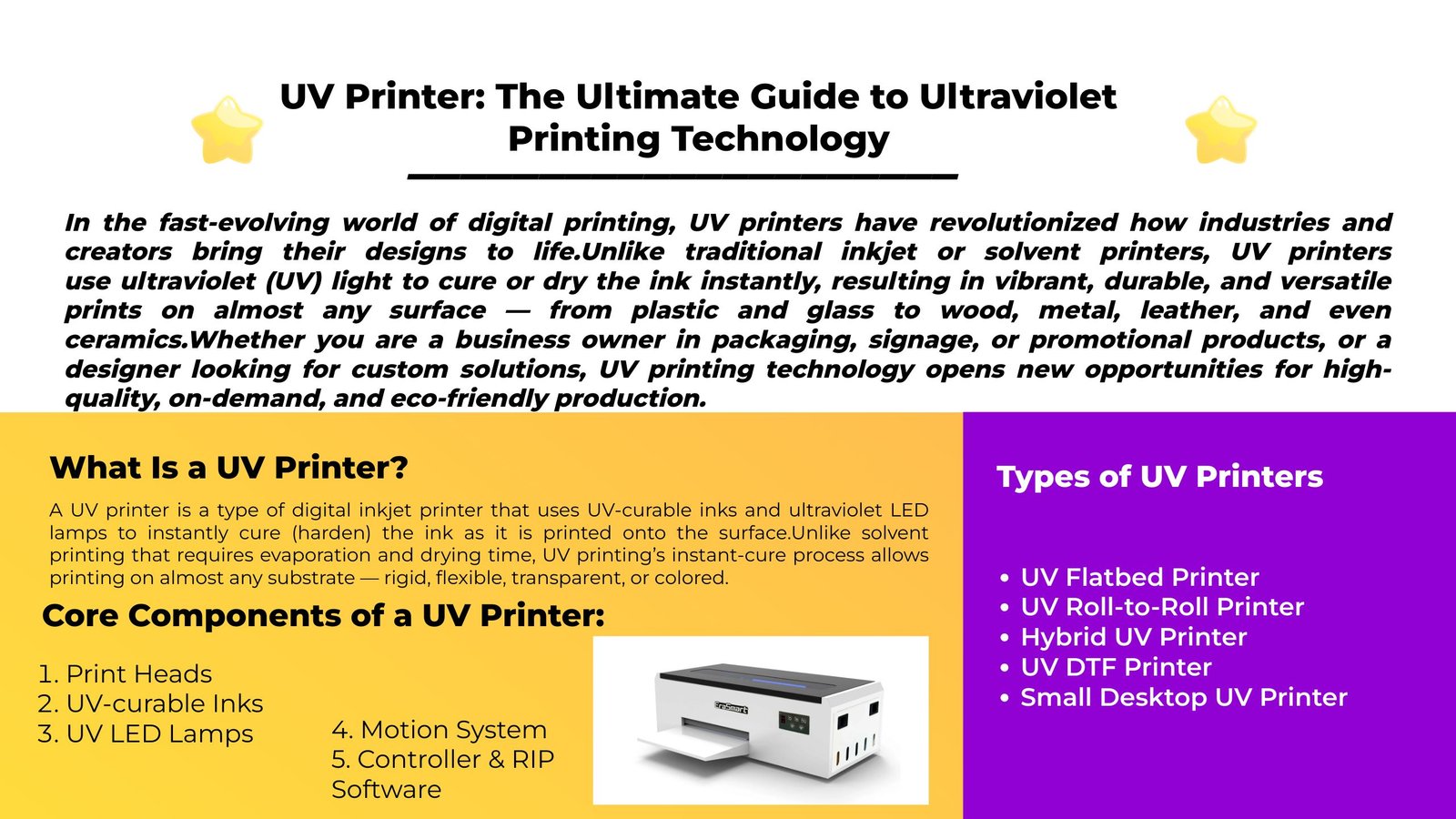
In the fast-evolving world of digital printing, UV printers have revolutionized how industries and creators bring their designs to life.
Unlike traditional inkjet or solvent printers, UV printers use ultraviolet (UV) light to cure or dry the ink instantly, resulting in vibrant, durable, and versatile prints on almost any surface — from plastic and glass to wood, metal, leather, and even ceramics.
Whether you are a business owner in packaging, signage, or promotional products, or a designer looking for custom solutions, UV printing technology opens new opportunities for high-quality, on-demand, and eco-friendly production.
A UV printer is a type of digital inkjet printer that uses UV-curable inks and ultraviolet LED lamps to instantly cure (harden) the ink as it is printed onto the surface.
Unlike solvent printing that requires evaporation and drying time, UV printing’s instant-cure process allows printing on almost any substrate — rigid, flexible, transparent, or colored.
Core Components of a UV Printer:
Compact entry-level model with L800 print head, ideal for small items and hobby projects (120*210mm print size).
L800 print head with 210*290mm print size, perfect for small businesses and personalized gifts (0-130mm print height).
DX7 print head with 350*450mm print size, suction platform, and CMYK+WW+VV for high-volume production.
XP600 print head with 350*450mm print size, 5㎡/H speed, ideal for medium to large production runs.
Dual XP600 print heads with 5.5㎡/H speed, CMYK+WW+VVVVVV for enhanced color gamut and productivity.
Dual XP600 print heads with 350*450mm print size, designed for industrial-grade continuous production.
Large-format 420*600mm printer with dual XP600 heads, perfect for signage, panels and large materials.
Dual XP600 heads with automatic lamination, specialized for UV DTF film printing (width up to 350mm).
Specialized for phone cases (TPV/PVC/wood/metal), with 10-inch display and 0-10mm adjustable height.
The design or artwork is processed by RIP (Raster Image Processor) software, converting it into printer-readable data.
The printer’s piezo print heads spray tiny droplets of UV-curable ink onto the substrate in a controlled pattern.
Immediately after the ink lands, UV LED lamps emit ultraviolet light that activates the photoinitiators in the ink, turning it from liquid to solid within milliseconds.
Because UV printing is non-absorptive, you can print multiple layers (for textures, 3D reliefs, or Braille effects) and achieve glossy, matte, or embossed finishes.
UV inks are specially formulated to cure under UV light instead of drying by evaporation. They contain:
Advantages of UV inks:
UV printing’s ability to print on non-porous materials is what sets it apart from other technologies.
Large-format UV flatbed printers produce durable outdoor and indoor signs, backlit panels, and exhibition displays.
UV printers allow direct printing on cartons, bottles, or packaging prototypes with instant proofs.
Used for custom printing on pens, USB drives, lighters, power banks, and gifts.
Print directly on control panels, keypads, or instrument casings.
Wood panels, glass walls, tiles, and furniture elements can all be customized with UV graphics.
UV DTF (Direct to Film) enables vibrant transfers on shoes, bags, and synthetic fabrics.
Q1: Can a UV printer print white ink? Yes. White ink allows printing on dark or transparent materials by creating a background layer.
Q2: Is UV printing waterproof and scratch-resistant? Yes. UV-cured inks form a hard coating that resists water, abrasion, and UV light.
Q3: Can I print on curved objects? Flatbed UV printers are designed for flat surfaces, but with jigs or UV DTF films, you can print on curved or irregular items.
Q4: How long does UV ink last? Typically 2–3 years outdoors and 5+ years indoors, depending on material and conditions.
Q5: What file formats are supported? Most printers accept TIFF, JPG, PDF, and PNG files through RIP software.
Q6: Are UV printers safe to use? Modern LED UV systems are safe and energy-efficient, but operators should avoid direct UV exposure.
UV printing aligns with global sustainability trends:
UV printing represents the future of digital printing — fast, clean, and incredibly versatile. With the ability to print vivid, full-color images on virtually any surface, UV printers have redefined personalization, manufacturing, and creative production.
For businesses seeking high-margin customization, eco-friendly printing, and on-demand manufacturing, investing in a UV printer is not just a technology choice — it’s a strategic advantage.
WhatsApp us