DTG Printer: The Complete Guide to Direct-to-Garment Printing
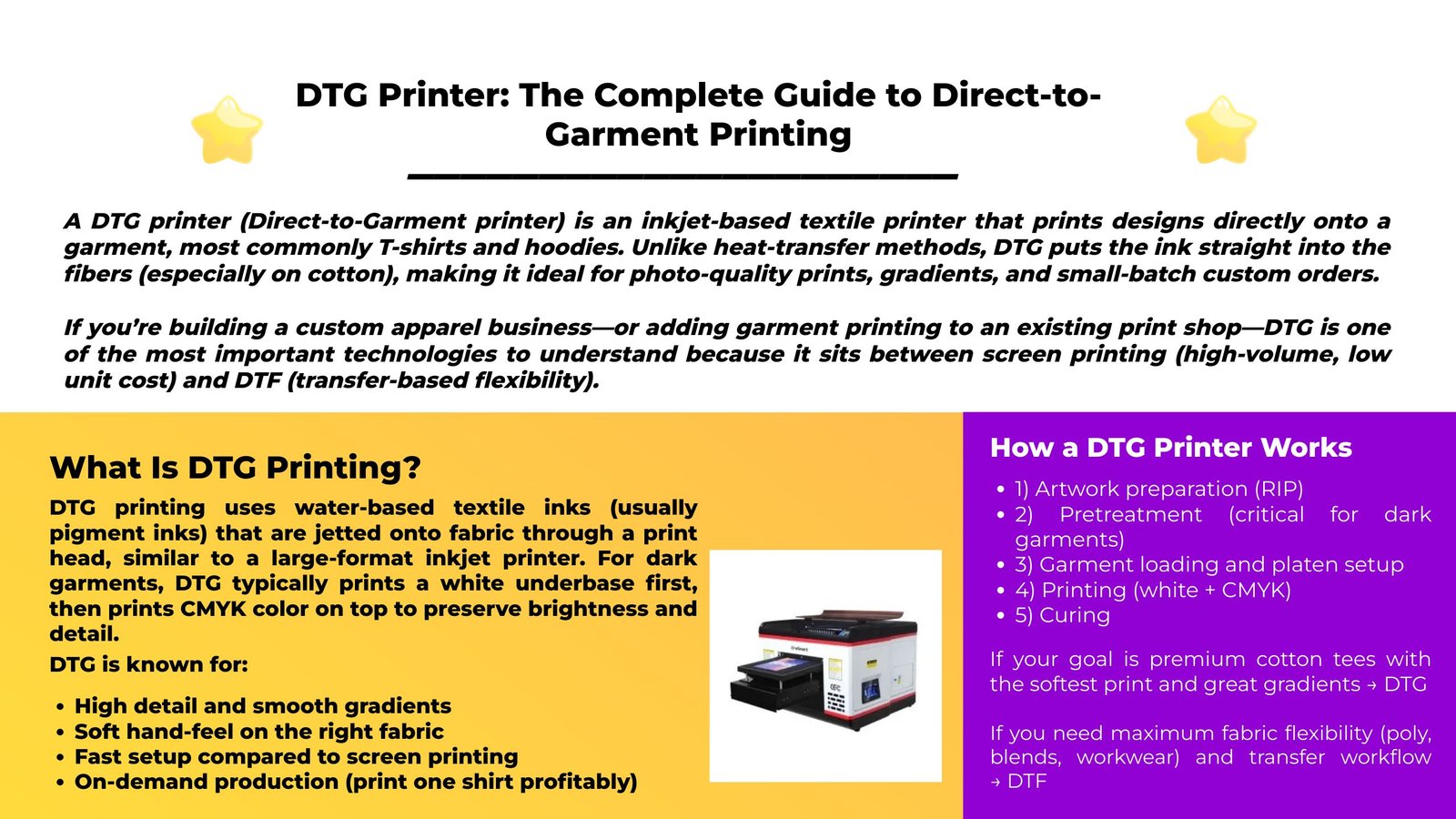
A DTG printer (Direct-to-Garment printer) is an inkjet-based textile printer that prints designs directly onto a garment, most commonly T-shirts and hoodies. Unlike heat-transfer methods, DTG puts the ink straight into the fibers (especially on cotton), making it ideal for photo-quality prints, gradients, and small-batch custom orders.
If you’re building a custom apparel business—or adding garment printing to an existing print shop—DTG is one of the most important technologies to understand because it sits between screen printing (high-volume, low unit cost) and DTF (transfer-based flexibility).
DTG printing uses water-based textile inks (usually pigment inks) that are jetted onto fabric through a print head, similar to a large-format inkjet printer. For dark garments, DTG typically prints a white underbase first, then prints CMYK color on top to preserve brightness and detail.
DTG is known for:
Your design is processed by RIP software, which controls:
Pretreatment is a chemical solution applied to the garment to help:
Pretreatment can be:
The shirt is stretched flat on a platen. Proper platen height and tension are essential for:
Curing fixes the ink into the garment using a heat press or conveyor dryer, ensuring:
DTG and DTF often compete for the same “custom T-shirt” market, but their strengths differ.
Rule of thumb:
Cold lamination is especially useful when heat could cause damage or distortion, since it doesn’t require temperature to activate the adhesive.
DTG performs best when ink can absorb and anchor into the fibers.
If you plan to print on a wide range of synthetics, DTG may not be your only technology.
Professional DTG output isn’t just about the printer—most quality issues come from process control:
DTG profitability depends on total cost per print, not just machine price.
DTG printers can produce amazing prints, but they demand discipline—especially with white ink.
Why DTG clogs happen: White ink contains pigment that can settle. If the printer sits idle, clogs become more likely. A consistent routine is the difference between a profitable DTG shop and constant downtime.
Cause: Underbase too thin, bad pretreat, incorrect profile Fix: Adjust white density, improve pretreat evenness, recalibrate profiles
Cause: Over-pretreat or uneven spray, wrong press settings Fix: Use a consistent spray pattern, reduce pretreat volume, adjust press time/temp
Cause: Too much ink load, under-curing, wrong pretreat Fix: Tune ink limits, confirm curing parameters, verify pretreat level
Cause: Garment not flat, platen height wrong Fix: Re-load garment, reduce wrinkles, re-check height clearance
Cause: Idle printer, poor humidity, dirty cap/wiper Fix: Daily nozzle checks, stabilize environment, keep cap/wiper clean
Before buying, decide what you’re optimizing for: speed, quality, reliability, or lowest upfront cost.
Look for:
If you print dark shirts daily, budget for:
DTG is a maintenance-heavy category. Fast parts + knowledgeable service can matter more than tiny spec differences.
DTG shines when:
DTG is less ideal when:
DTG stands for Direct-to-Garment, meaning the printer prints directly onto the fabric.
Usually:
Yes—when pretreat and curing are done correctly. Most durability complaints trace back to process issues, not the technology.
Some systems can, but it’s generally more challenging than cotton due to dye migration and adhesion behavior. Test your exact garments.
A DTG printer is worth it if your business needs:
To succeed with DTG, treat it like a production system, not just a machine: pretreat consistency + curing discipline + maintenance routine are what turn DTG into a reliable profit center.
One model, fully optimized for stable white ink printing, anti-clog maintenance, and easy daily operation—ideal for custom apparel, small shops, and on-demand production.
WhatsApp us