DTF Printing vs. Sublimation Printing: Which One Is Better for Your Business?
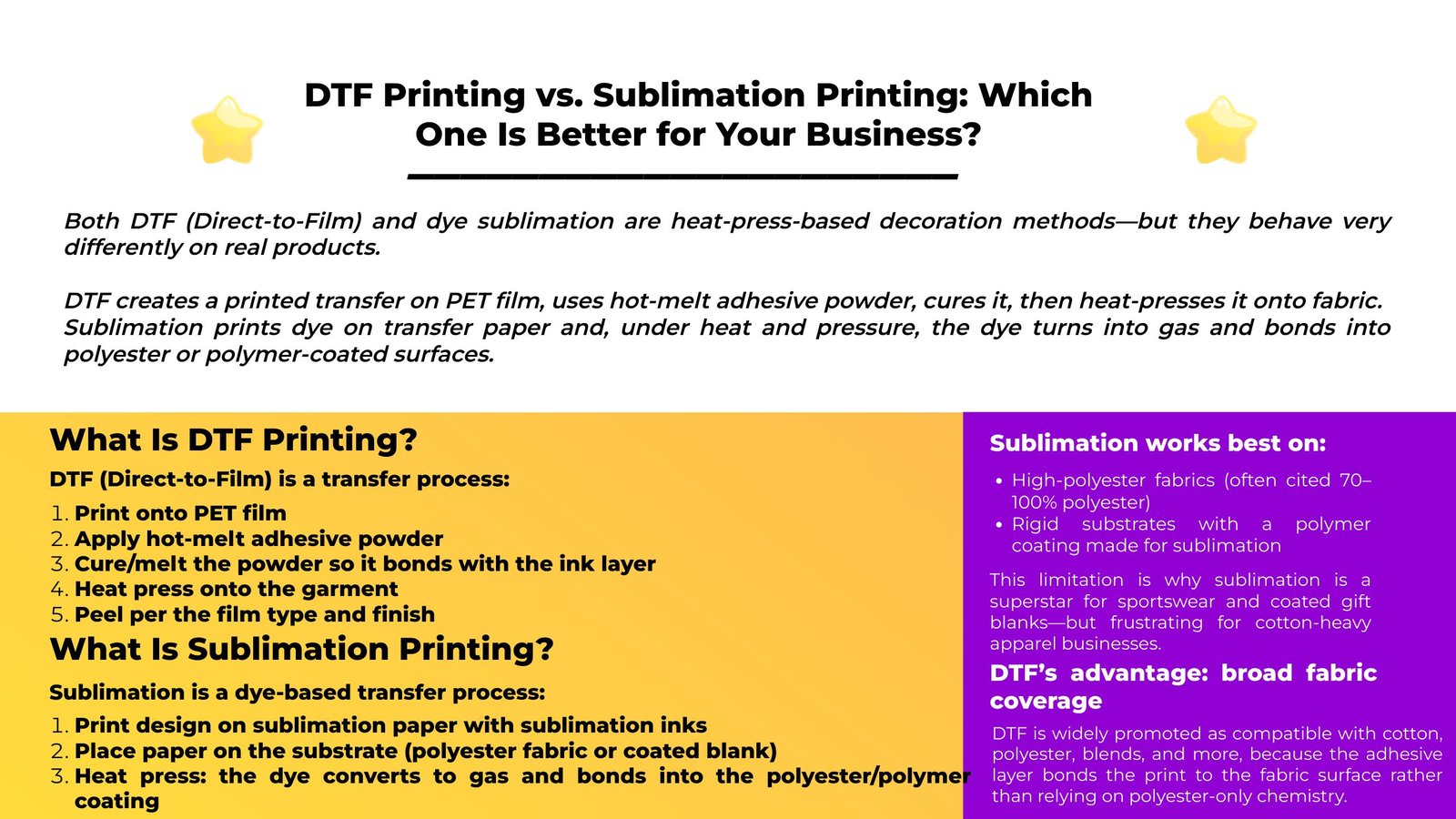
Both DTF (Direct-to-Film) and dye sublimation are heat-press-based decoration methods—but they behave very differently on real products.
The big separator is materials: sublimation fundamentally needs polyester/polymer chemistry, while DTF is built to transfer onto a much wider set of fabrics.
DTF (Direct-to-Film) is a transfer process:
This “film + powder + cure + press” workflow is explained in many step-by-step guides and is the reason DTF is popular for garment shops that need flexibility.
More About DTF Printer: DTF Printer: The Complete Guide to Direct-to-Film Printing Technology
A production-ready solution designed for shops that need higher throughput and a more automated workflow.
A practical choice for startups and small studios that want reliable output without over-investing.
Balanced performance for print shops that need speed + stable output in an A3 footprint.
Designed for users who prioritize fine detail, smooth gradients, and premium print feel.
A dependable A3 model for steady daily output, popular for small-business production routines.
Compact entry-level model perfect for startups and small batch production.
Enhanced A4 model with improved ink efficiency for daily small-scale production.
A3 format printer with reliable R1390 motherboard for medium production.
Standard A3 model with 250ml ink tanks for consistent daily operation.
L1800 print head model offering superior color reproduction for detailed designs.
A3 Max series with XP600 print head for increased speed and efficiency.
High-performance A3 model with DX7 print head for professional results.
High-performance A3 model with XP600 print head for professional results.
Professional dual print head A3 printer for high-volume production.
Industrial wide-format printer with dual XP600 heads (620mm width).
High-speed industrial model with dual I1600 heads (10㎡/h output).
Premium industrial printer with dual I3200 heads for maximum productivity.
Sublimation is a dye-based transfer process:
Many explanations describe sublimation occurring around the typical heat-press range (often cited around 350–400°F) where the dye transitions and penetrates polyester/polymer surfaces.
Sublimation works best on:
This limitation is why sublimation is a superstar for sportswear and coated gift blanks—but frustrating for cotton-heavy apparel businesses.
DTF is widely promoted as compatible with cotton, polyester, blends, and more, because the adhesive layer bonds the print to the fabric surface rather than relying on polyester-only chemistry.
If your shop prints “whatever the customer brings” (cotton tees, hoodies, blends, uniforms), DTF usually fits more orders without changing blank strategy.
Because sublimation dye becomes part of the polyester/polymer surface, the print is often described as embedded, meaning it won’t crack/peel like a surface layer can.
DTF prints sit on top of the fabric as a bonded layer. Durability depends heavily on:
When tuned correctly, DTF is positioned as long-lasting and resilient, but it remains a “transfer layer,” not an embedded dye.
Sublimation is widely used for large-area designs—especially patterns and all-over apparel—because the process can cover extensive areas of polyester fabric when set up correctly.
DTF is excellent for:
DTF adds steps: powdering + curing before heat pressing. That can mean more equipment and more process control.
Sublimation is often operationally simpler (print paper → press), but it forces you into:
Costs vary wildly by brand and scale, but the cost structure is usually:
A common business reality: sublimation equipment can be easier/cheaper to start with, but sublimation blanks (poly garments, coated items) can shape your margins and product strategy.
Industrial IAQ discussions note DTF can produce dust, smoke, and fumes during printing and curing, and recommend proper ventilation/filtration. Some hot-melt powder safety documents recommend respiratory protection when airborne dust levels are high.
Sublimation involves heating dyes; multiple safety guides recommend good ventilation during pressing to reduce exposure to fumes/vapors.
A common strategy is “DTF for apparel flexibility + sublimation for polyester/blank gifts” rather than forcing one method to do everything.
Pick DTF if any of these are true:
Pick Sublimation if any of these are true:
Not well in the traditional sense—sublimation is primarily for polyester/polymer-coated surfaces. Workarounds exist (special vinyl layers), but it changes the product feel and workflow.
Yes—DTF is commonly used on polyester and blends, but pressing parameters and garment type still matter for best results.
DTF is usually the clear winner because sublimation is best on light polyester due to dye transparency.
Sublimation is often considered extremely durable because the dye is embedded in the substrate, while DTF durability depends on correct powder curing and pressing.
Sublimation is excellent for polymer-coated hard blanks. DTF is mainly a fabric transfer system.
Many beginners find sublimation simpler (print → press), but only if they’re okay with polyester/coated-only product lines. DTF has more steps (powder/cure) but covers far more apparel types.
WhatsApp us