DTF Printer: The Complete Guide to Direct-to-Film Printing Technology
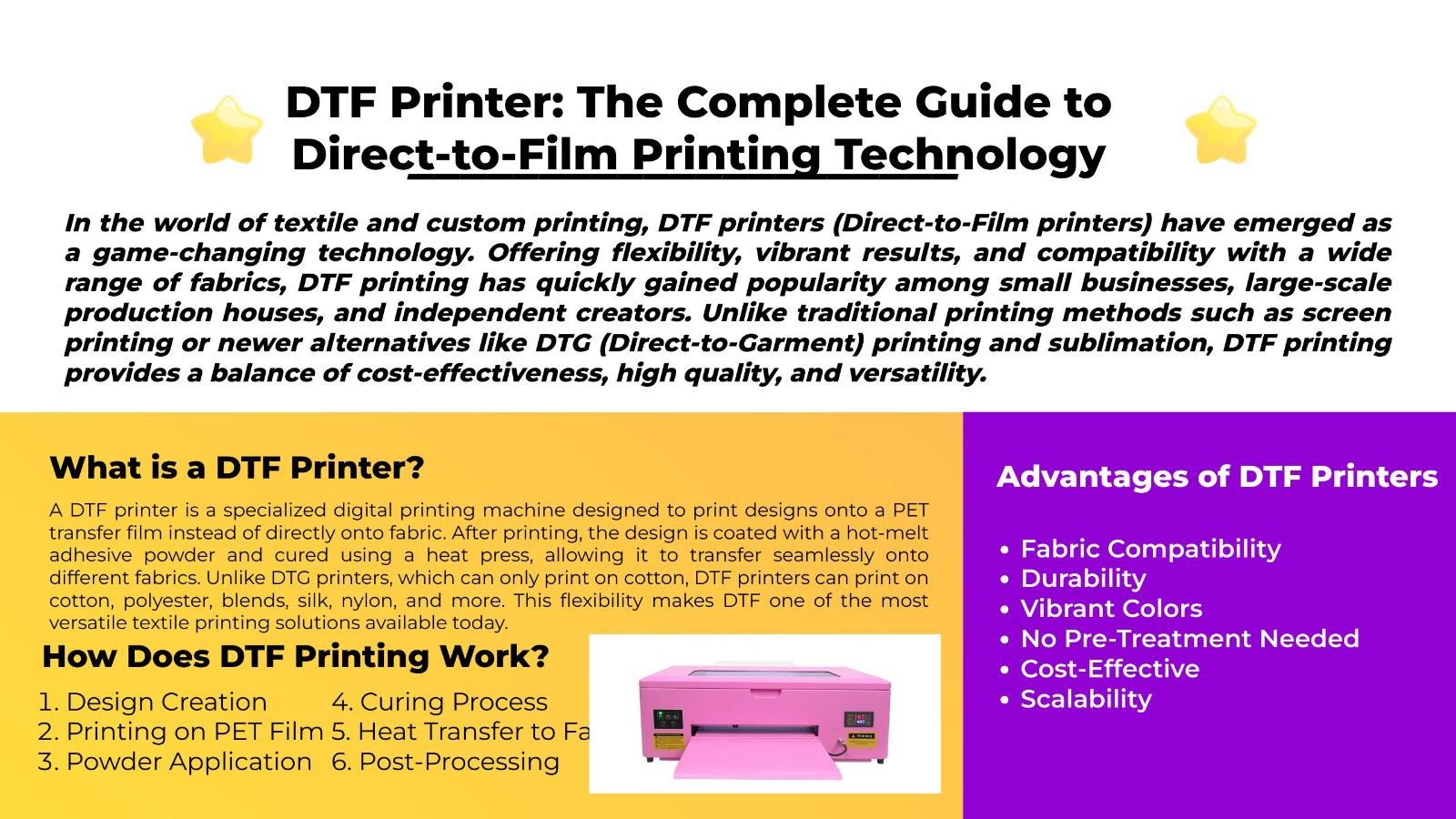
In the world of textile and custom printing, DTF printers (Direct-to-Film printers) have emerged as a game-changing technology. Offering flexibility, vibrant results, and compatibility with a wide range of fabrics, DTF printing has quickly gained popularity among small businesses, large-scale production houses, and independent creators. Unlike traditional printing methods such as screen printing or newer alternatives like DTG (Direct-to-Garment) printing and sublimation, DTF printing provides a balance of cost-effectiveness, high quality, and versatility.
This comprehensive guide will explore everything you need to know about DTF printers—from how they work, their advantages, and common applications to a comparison with other printing technologies.
A DTF printer is a specialized digital printing machine designed to print designs onto a PET transfer film instead of directly onto fabric. After printing, the design is coated with a hot-melt adhesive powder and cured using a heat press, allowing it to transfer seamlessly onto different fabrics.
Unlike DTG printers, which can only print on cotton, DTF printers can print on cotton, polyester, blends, silk, nylon, and more. This flexibility makes DTF one of the most versatile textile printing solutions available today.
Compact entry-level model perfect for startups and small batch production.
Enhanced A4 model with improved ink efficiency for daily small-scale production.
A3 format printer with reliable R1390 motherboard for medium production.
Standard A3 model with 250ml ink tanks for consistent daily operation.
L1800 print head model offering superior color reproduction for detailed designs.
A3 Max series with XP600 print head for increased speed and efficiency.
High-performance A3 model with DX7 print head for professional results.
High-performance A3 model with XP600 print head for professional results.
Professional dual print head A3 printer for high-volume production.
Industrial wide-format printer with dual XP600 heads (620mm width).
High-speed industrial model with dual I1600 heads (10㎡/h output).
Premium industrial printer with dual I3200 heads for maximum productivity.
The DTF printing process typically involves the following steps:
Design Creation
Printing on PET Film
Powder Application
Curing Process
Heat Transfer to Fabric
Post-Processing
While powerful, DTF printing has some drawbacks:
Unlike sublimation (which works only on polyester) or HTV (which requires smooth surfaces), DTF printing works on cotton, polyester, blends, nylon, leather, and more.
👉 This versatility makes it perfect for:
DTF printing does not require fabric pre-treatment, unlike DTG (Direct-to-Garment) printers, which need a special coating. This saves time, effort, and money, especially in bulk production.
DTF prints bond strongly with fabric fibers, resulting in:
Customers love prints that last as long as the garment itself, and DTF delivers just that.
With CMYK + White inks, DTF printers can produce bright, vibrant colors on both dark and light fabrics. This means:
Unlike screen printing (which requires setup, stencils, and bulk orders), DTF printing is economical even for single prints.
This makes DTF printers a great choice for businesses with high order volumes.
DTF prints have a soft hand feel compared to vinyl, which can feel heavy or rubbery. Customers prefer garments that feel natural while maintaining vibrant prints.
Many businesses find that DTF printers use less white ink compared to DTG printers, reducing costs over time.
DTF printers are widely used across industries:
Fashion and Apparel
Sportswear and Uniforms
Promotional Products
Home Décor
Industrial and Workwear
If you’re planning to invest in a DTF printer, consider the following:
As technology advances, DTF printing is expected to:
DTF printers are used for printing high-quality, full-color designs onto fabrics and textiles via heat transfer films.
Yes. Unlike sublimation printers, DTF printers can print on cotton, polyester, blends, silk, and more.
Yes. With proper curing and pressing, DTF prints are wash-resistant, flexible, and long-lasting.
DTF prints on films and transfers to fabric, while DTG prints directly onto garments. DTF works on more fabric types and does not require pre-treatment.
It depends. Sublimation produces permanent, lightweight prints but only works on polyester. DTF is more versatile across fabric types.
Yes. Industrial DTF printers can handle bulk orders, making them ideal for businesses.
DTF printers are revolutionizing the textile and garment printing industry. They offer a cost-effective, versatile, and durable solution for businesses and individuals looking to create high-quality custom prints on a wide range of fabrics. By eliminating the limitations of DTG and sublimation printing, DTF technology is quickly becoming the preferred choice in the world of custom apparel and promotional printing.
WhatsApp us